Storm Water Management
The Sands’ lakes are central to storm water management across North Torquay, consolidating flows and “filtering” a significant amount of the storm water run-off before discharging into the Karaaf Wetlands. In addition to this very important function, the lakes are a delicate ecosystem that is home to a diverse range of flora and fauna, and provide aesthetic and other qualities much valued by the residents of the Sands.
The predominant source of contamination of our lakes emanates from soil erosion across building sites and development lands in estates above the Sands. These stormwater flows enter our lake system via Sands Amenity Lake 1 (ie. lake in between 1st and 2nd fairway) via retention ponds within the Dunes and Zeally Sands. There is an argument, not substantiated, that these existing retention pond systems are over-burdened, particularly at times of peak flows that happen after a significant rain event. There are other sources of storm water inflow that are not captured by existing settling pond infrastructure, for example across the Stretton development, which are not “pre-treated” in any way before they arrive in Sands Amenity Lake 1. The nature and quantity of contamination is beyond the Sands lake’s capacity to filter and settle effectively, and the source is beyond our direct control to rectify. We therefore need to influence other parties, principally Council and Developers to clean up the storm water inflows in order to give our lakes a fighting chance to do what they are designed to do.
The initiatives arising from our first engagement with Council (Jan 19th) placed focus on the stormwater controls (or lack thereof) at building sites above the Sands. Subsequently Council undertook extensive site management plan compliance audits and instigated action to improve compliance on building sites. Pleasingly we did see visible evidence of corrective action – hay bales and other temporary filters, temporary down-pipes, removal of site debris, etc.
The focus then shifted to the bare tracts of land cleared by developers creating estate infrastructure. The Stretton development, for example, is “unprotected” in that its runoff is not being trapped. Over the time that we have been engaging with Council we have seen a new condition imposed upon the developer wherein the developer will not be able to commence works on the next stage until the retention pond system is constructed. This will be beneficial into the future but offers nothing in the short term.
Due to subdued inflows, the water quality did improve across the dryer months however the current rains have re-established the flow of contamination. In all likelihood, the benefits of improved building site compliance is probably masked by the impacts of the continued expansion of new estates without adequate settling ponds to pre-treat the run-off before it enters the Sands.
Council did undertake a review of the Torquay North Stormwater Management Plan and concluded that no change is required – that is the Council is convinced that the planned infrastructure is appropriate. That said, estate development (earthworks and construction) has and continues to advance ahead of the development of the planned stormwater infrastructure so it should be no surprise that the downstream lakes and in turn the Karaaf Wetlands are from time to time inundated with contaminated inflows.
Recognising that the rain season was coming our most recent effort has been to enlist Council’s support to bring the effectiveness of the existing sediment basins that feed the Sands lakes up to best condition in order to do the job they are designed to do. There has been some action here but not what we wanted as Council’s call is that the basins are in working order. Council have however recognised that more can be done on the building sites and they have now enlist the support of the EPA to assist with compliance management.
In summary, there is no one party that is responsible for the contamination in our lakes. Council is however best placed to motivate and effect change that can directly improve storm water quality thus our efforts will continue to be directed at how we assist and influence Council to take action. To that end we are looking to other key stakeholders that can assert influence – parties such as Parks Victoria who have stewardship of the Karaaf Wetlands which is part of the Bremlea flora and fauna reserve. Direct engagement of Councillors and potentially the media, whilst tried before, need to be and are being considered again.
Our work continues….
Estate Maintenance
- A three year agreement is in place with WCG to maintain the nature strips and the common areas of the Sands Estate. It includes a detailed schedule of works by month which will form the basis of tracking and reporting performance. A summary of the maintenance schedule is at the bottom of this page.
- Following from the recommendation of the arborist, who recently audited the estate’s street trees, 6 dead or dying trees posing some risk have been cut down. Stump removal is imminent and once completed replacement Sheoak trees will be planted. The focus now is to establish an on-going management plan for our trees, assessing options that span varying amounts of oversight by OC1 and/or Council.
- The new signage that alerts residents to upcoming nature strip mowing events continues to have good effect with far fewer nature strips not being mowed because of vehicles impeding access.
- An independent and accredited third party testing laboratory has been appointed to periodically test the quality of the water in the lakes. We are sharing this cost with WCG. The testing will enable us to meet the obligations of the environmental management plan that envelopes our estate, and to monitor the success of council’s actions to minimise the sediment in the storm water run-off that enters the Sand’s lakes. Furthermore, we are now investigating whether we can merge our lake water testing with that done by the Council accross ours and other upstream sediment ponds to eliminate duplication and improve its relevance by creating a single “whole of system” picture of the effectiveness and health of the storm water run- off infrastructure (including our lakes).
Estate Amenity
- In-house efforts to repair the weir between the 1st and 2nd fairways have failed with repairs being breached at the first heavy rainfall to follow completion of the works.The need to repair the the weirs is unchanged understanding that a major failure could be catastrophic in terms of loss of water, lake amenity, damage to infrastructure etc. As such the estate amenity sub-committee have sought out suitably qualified and experienced organisations to quote the conceptual engineering, project design and works management. Quotations will hopefully be received and assessed before the end of the current rain season so that a preferred vendor can be selected and ready to commence work once the rains abate. Works will be scoped to include the construction of a new weir at the bottom of amenity lake 5.
- Unwanted reeds are now reaching problematic levels in some areas of the lakes. As such the estate amenity sub-committee have reached out to GHD Consulting in the first instance to provide advice in relation to measures that can be taken to control these infestations of reeds, and other weeds that populate our lake boundaries. As with any major works a second vendor will be identified to quote on the required work.
- Concerns have been raised in relation to the lack of clear identification of the entry points into the Sands estate, this being particularly evident following the connection of St Georges Way and Lowtide Drive. The estate amenity sub-committee is investigating options to place signage at the entry points into the Sands Estate having regard for the other stakeholders which include the golf club, WCG and the Council.
- Finally there is a private sewer located adjacent to the Esplanade that services the houses along the Esplanade with the Sands. the sewer may not currently meet the requirements of Barwon Water who are the natural owners of the sewer, as they are of all the other sewers that service the Sands Estate. A project has been activated to understand the options available to WCG and OC1 to move, upgrade if necessary, the private sewer to an entity better placed to maintain such a facility on-going, namely Barwon Water.
Estate Maintenance Schedule
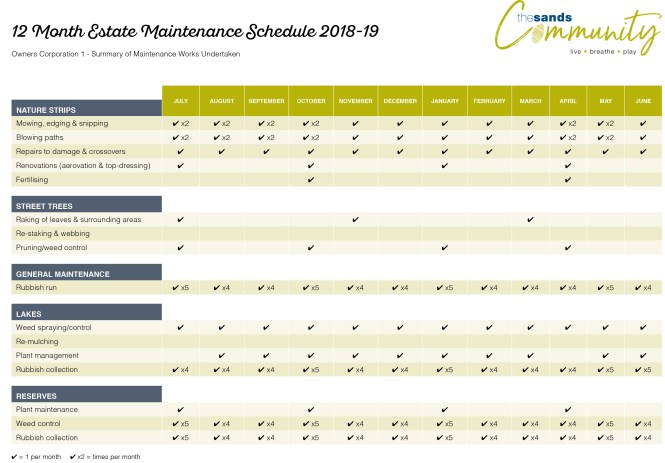
Download pdf: 12-month-maintenance schedule
Estate Tree Health Report
Drysdale based arborist “Let’s Talk About Trees” conducted a visual inspection of all street trees on the estate. You can view the report by clicking on the link below:
 The Sands Community :: What's On